

Is Tamil Nadu headed for a Shiv Sena-like drama?
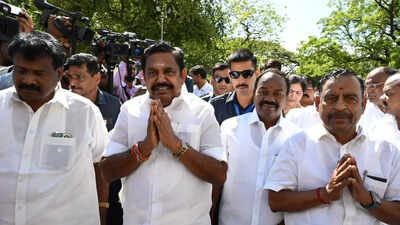
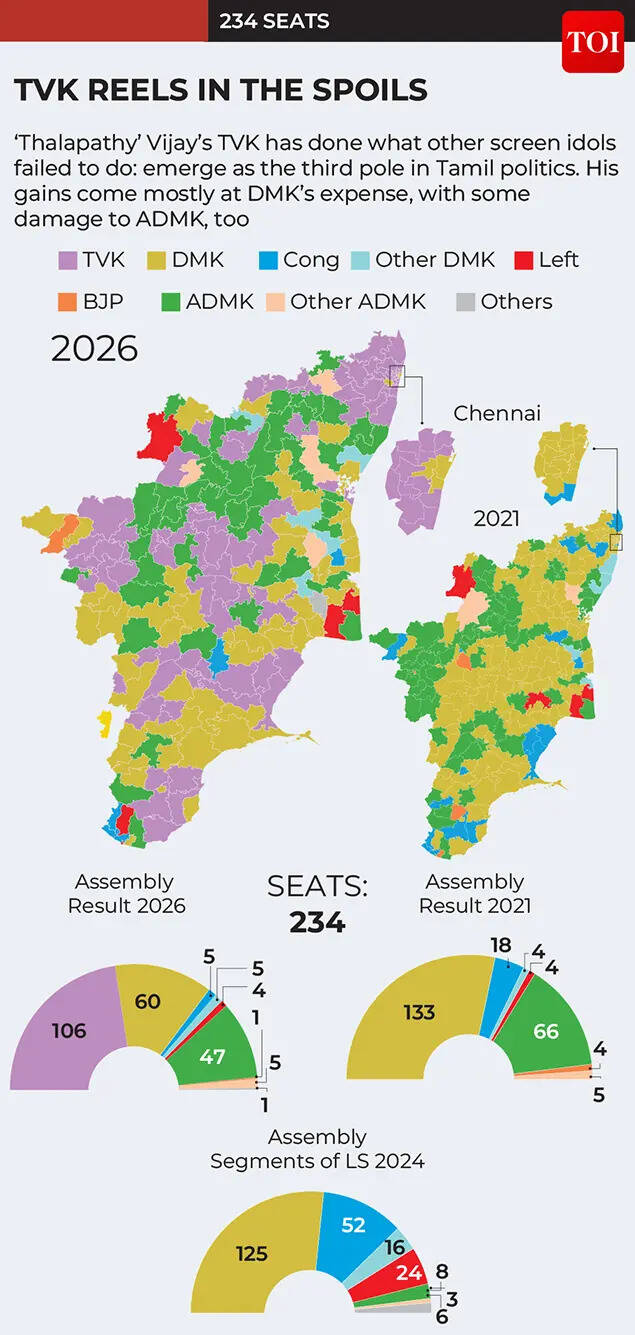
New Delhi: Fractured mandate or fractured party? split between AIADMK In Tamil Nadu, much like the Shiv Sena split in Maharashtra, they often do.In June 2022, Eknath Shinde led a revolt in the Shiv Sena and captured two-thirds of the party’s MLAs, bringing down the Maha Vikas Aghadi government. The coup split the party vertically into rival camps led by Shinde and Uddhav Thackeray.A similar script unfolded in Tamil Nadu on Wednesday when the rebel AIADMK camp led by CV Shanmugam and SP Velumani backed Vijay’s minority government during the floor test despite the party whip instructing legislators to vote against it.This split Amma’s AIADMK into two factions, with 25 rebel MLAs on one side and 22 on the other.This came despite AIADMK general secretary Edappadi K Palaniswami saying the party would not support the newly elected TVK government and alleging that it was trying to woo legislators with offers of ministerial posts and board chairmanships.The crisis now raises a question: Can the AIADMK go for a Shiv Sena-style split?AIADMK Vs AIADMKThe series of incidents started after the Tamil Nadu assembly elections were given a fractured order with no party crossing the majority mark.TVK emerged as the single largest party with 108 seats, but lacked the numbers needed to form a government on its own. The DMK, which had won the previous elections, saw its tally fall to 59 seats, while the AIADMK managed to win only 47 seats. Among the smaller players, CPI and CPM won two seats each, VK got two seats and IUML retained both contested constituencies. Congress managed to win five seats, PMK won four, while AMMK and BJP opened their accounts with one seat each.This has pushed the political parties in the state into a post-poll numbers gameReportedly, the AIADMK and the DMK – the Dravidian rivals – had entered into talks to prevent Vijay from forming the government. AIADMK leaders alleged that EPS sought the post of chief minister through such arrangements.This move, however, did not sit well with a large section of the party.Subsequently, the rift within the AIADMK came to light when a group of legislators submitted a letter to pro tem speaker MV Karupaiah seeking the appointment of former minister SP Velumani as the leader of the AIADMK legislature party.
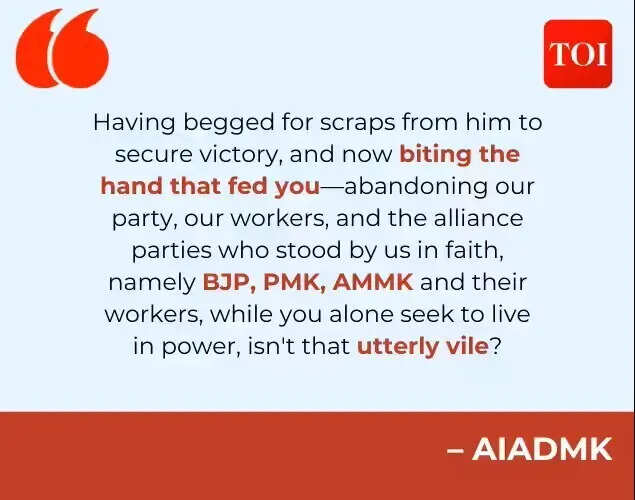
Later, 25 AIADMK MLAs from the rebel camp voted in favor of the TVK government during the trust vote.CV Shanmugam defended the decision, saying that the AIADM had to adapt to new political realities after its poor electoral performance. He said the party should support TV in what he described as “mother’s rule”.EPS removes insurgents; Shanmugam cries foul Hours after the floor test, Palaniswami removed 26 office-bearers from the party, including CV Shanmugam, SP Velumani, R Kamaraj, C Vijayabaskar and Natham R Viswanathan.The Palaniswami camp maintained that the whip issued by SS Krishnamurthy, appointed by the government leadership, was legally valid and binding on all MLAs. Palaniswami himself announced in the Assembly that AIADMK MLAs must vote against the government.The EPS also claimed that the AIADMK legislative party has already been formally formed with him as its leader.
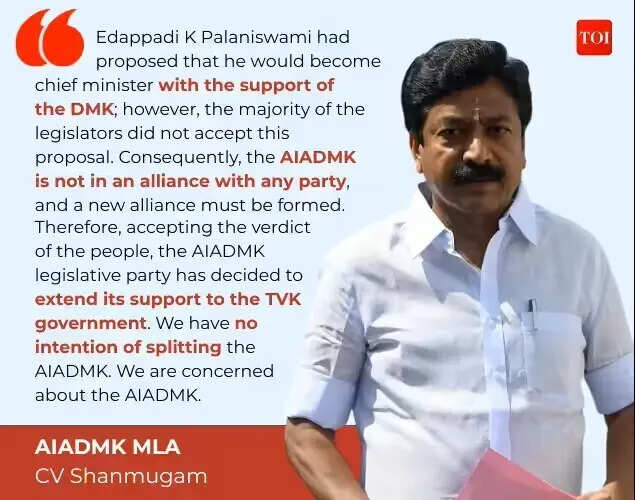
Shanmugam, meanwhile, dismissed the disciplinary action as illegal and said Palaniswami had no authority to remove them. He also questioned how punitive measures could be taken without first investigating the reasons for the election defeat through the party’s general assembly.Shanmugam also claimed that no explanation was sought from the rebel leaders before taking action.what Anti-Defection Act saidAIADMK MP IS Inbadurai demanded that anti-defection laws be brought against MLAs who voted for the government by ignoring the party whip.Under the Tenth Schedule of the Constitution, MLAs can be disqualified on two main grounds:
- If they voluntarily give up their membership of the party on whose ticket they were elected.
- If they vote against or abstain from voting against the party whip without prior permission, and the party does not condone this action within 15 days.
However, anti-defection proceedings depend on whether the whip was validly issued and properly communicated to legislators.what nextNow, a split in the Tamil Nadu Assembly in the AIADMK may lead the party’s MLA leader Palaniswami to file a disqualification petition against the rebel MLAs. This will force Speaker JCD Prabhakar to decide whether the rebel MLAs have violated the party whip under the Tenth Schedule.But any judgment of the Speaker can be challenged in court.Meanwhile, the fight over control of the AIADMK and its “two leaves” symbol may eventually reach the Election Commission, which is not bound by the Speaker’s inquiry into anti-defection proceedings.Supreme Court verdict against Shiv SenaIf the legal battle over control of the AIADMK reaches the courts, the Shiv Sena may rely on the Supreme Court’s 2023 constitution bench judgment in the split case.In the Shiv Sena v Shiv Sena case, the apex court held that “political parties” – and not just legislative parties – have the power to appoint whips and leaders in the House.The court also ruled that the Speaker cannot recognize a party as a “real” party because it refers to more legislators. Instead, the Speaker must examine the structure and constitution of the main political party.other routesRebel legislators can face disqualification if their numbers fall below the two-thirds threshold required for protection under the merger provisions. In the case of the AIADMK, the rebel camp will need at least 32 MLAs to avoid disqualification while in the assembly.But resignation points the other way.If rebel MLAs resign and the Speaker accepts their resignation, they immediately cease to be MLAs, making anti-defection measures irrelevant as the law applies only to sitting MLAs.Unlike disqualified MLAs, MLAs who resign before disqualification are not barred from contesting by-elections. In 2019, the Supreme Court allowed rebel MLAs in Karnataka to contest by-elections despite the disqualification order by the Speaker.
In effect, resignation allows rebels to bypass the two-thirds requirement altogether.There is still another option near the Velumani-Shanmugam camp.If the rebels can get more AIADMK MLAs on their side and cross the two-thirds mark – 32 MLAs in the party’s case – they can avoid disqualification and claim the “real” AIADMK as the legislative party.That’s exactly the path Shinde followed in Maharashtra in 2022. He walked away from the Thackeray government with more than two-thirds of Shiv Sena MLAs, survived the anti-defection drive and ultimately won the battle over the party’s name and symbol. A similar drama played out in Madhya Pradesh in 2020, when 22 Congress MLAs supporting Jyotiraditya Scindia defected, toppling the Kamal Nath government and clearing the way for the BJP’s return to power under Shivraj Singh Chouhan.