

Vikram’s ‘hop’ unravels surficial ‘layers’ near lunar south pole region | India News
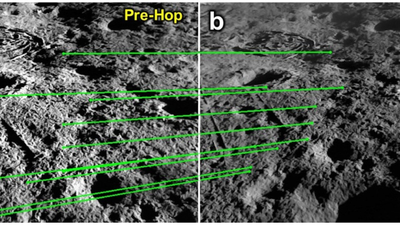
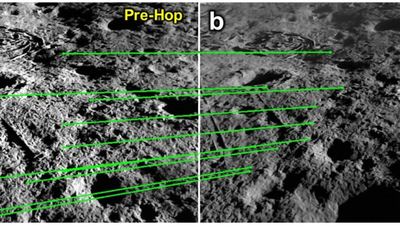
Bengaluru: When Vikram, India’s lunar lander, briefly lifted off and settled back on the moon in 2023, it marked a small but telling moment in the Chandrayaan-3 mission. Now, that short “hop,” which lasted about 3 minutes, is helping scientists piece together what lies just below the lunar surface through very precise measurements.The maneuver toward the end of the mission moved the lander about half a meter, giving researchers a rare opportunity to study a patch of untouched soil nearby and compare it to the original landing site.Once the lander stabilizes, a temperature probe called ChaSTE (Lunar Surface Thermophysical Experiment), one of the lander’s core instruments, is pushed back to the ground. This time, only five of its ten sensors were able to penetrate the ground, as the new site sat on a slightly steep slope in a small crater. Still, it recorded how heat moved through the ground during a brief window before sunset—about a lunar hour of observations, with some gaps due to mission constraints.These results are from a study led by K Durga Prasad at the Physical Research Laboratory (PRL), published in The Astrophysical Journal.The results show that the moon’s surface is not flat. Instead, it consists of layers that behave differently. The top few centimeters form a layer that conducts heat more easily, while the bottom material is less conductive. This layered structure changes how the surface heats during the day and cools as night approaches.The hop itself changed the soil. When Vikram fired its engines, the force appeared to blow away about 3 centimeters of topsoil, exposing the denser material below. In fact, the lander “digs” into the surface involuntarily without using a drill. Surprisingly, such local perturbations over only half a meter were unexpected—soil properties are generally uniform over such short distances.It revealed another key feature. Soil becomes more compact with depth. Near the surface, it is loose and porous, but within just a few centimeters, it becomes denser and more tightly packed. Such variations can affect how stable the ground is for landers and rovers. These measurements suggest that the polar region has its own distinct character, significantly different from what the Apollo and Surveyor missions had found in the equatorial region decades earlier.The probe also tracked temperature changes during twilight. As the sunlight faded, the ground cooled steadily before the temperature dropped sharply. The top layer reacts faster than the bottom layers, again indicating compositional differences.These results are important beyond this single test. The Chandrayaan-3 landing site is located in the south polar region of the Moon, an area of interest because it may contain frozen water. Understanding how heat moves through the soil can help scientists predict where such ice might survive and stabilize.The study also shows how sensitive the lunar surface is. Even a brief engine firing changes the top layer enough to reveal what lies below. Future missions, especially those aimed at collecting samples or building infrastructure, will need to take such effects into account.In the end, a hop lasting about three minutes offered a clear picture of the moon’s surface, showing that even small movements can yield valuable scientific clues.