
Women’S Reservation Bill: Parliament seats may be increased to 816 for 1/3rd women’s reservation | India News
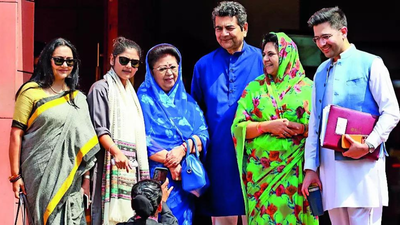
New Delhi: The government intends to introduce at least two bills in the current session of Parliament – including constitutional amendments – to reserve one-third seats for women in the upcoming Lok Sabha elections and the subsequent Assembly elections. The move promises to change the country’s political landscape and put an authoritative stamp on Prime Minister Modi’s much-talked-about agenda of women’s empowerment as he campaigns for four state assemblies. If the government has its way, the number of LS seats will increase by 50% to 816 from the current 543, with a 273-seat increase for women, ensuring that existing political dynamics and current MPs, overwhelmingly male, do not loosen as a reshuffle takes over. The majority mark, accordingly, will move to 409. For the first time in five decades, the LS will increase in power. The powers of the Rajya Sabha and Legislative Council in the states will not be affected. At least two bills will be introduced, one on boundaries and another to amend the constitution, requiring two-thirds support in both houses. Although the ruling NDA does not have the power to pass the bill on its own, the government seems keen to push for its passage during the budget session that ends on April 4. Failing that, it is open to the idea of convening a short session specifically on women’s quota. Home Minister Amit Shah is leading efforts to get support for the two bills and held two meetings on Monday, one with regional parties in the non-NDA bloc including opposition parties and one not aligned with the formation (NDA or India Bloc) and another with allies of the BJP. The Women’s Quota Act, pushed by the Modi government in 2023, linked enforcement in legislatures to delimitation to be conducted after the census, which is due. The delimitation plan could increase seats by 50% across the state People in the know said Shah emphasized the government’s inclination to delink the existing law’s provision to implement quotas after the upcoming census and instead introduce a new demarcation based on the 2011 census, the latest enumeration exercise.The proposal to rely on the 2011 census is intended to ensure the introduction of women’s quota by the 2029 LS elections, as the release of data from the upcoming census may take some time and there may be insufficient time to complete the nationwide delimitation exercise. “We were told that the government is keen to introduce the quota from the elections to be held after March 31, 2029. If it wants to take a few more days to build a consensus, the budget session may be extended or even called after adjournment for a few days,” said a person aware of the development. States like UP and Bihar will see their Lok Sabha constituencies go from the current 80 and 40 to 120 and 60 respectively, and Kerala will go from 20 to 30.In states with odd numbers (TN has 39), the Boundary Commission will work in detail but the jump will be in the same ratio.The government believes that the proposal to retain proportional power of each state/UT in the LS by increasing their share to 50% addresses the concerns of the southern states, which fear a reduction in their representational power in Parliament due to their successful efforts to control population compared to the northern states. Seats reserved for SC/STs will also be covered under similar provisions. The current LS has 84 seats for SCs and the number is expected to go up to 126, while the constituencies reserved for STs may go up from 47 to 70. Some Union Territories and States with one or two LS seats have their constituencies reserved for women in every third election, while seats reserved for women in open categories are for three terms.While 22 MPs representing various parties attended the NDA meeting, representatives of Samajwadi Party, Shiv Sena (UBT), BJD and YSR Congress were part of another meeting with Shah. Some opposition parties, including the Congress and the Left, have pressed for an all-party meeting. The TMC — which has often cited Bengal Chief Minister Mamata Banerjee’s promotion of women in the party’s representation in parliament and the assembly to emphasize its pro-feminist leanings over others — also skipped the meeting. Parties like Congress and SP have pushed for OBC quota within the women quota.Although the NDA enjoys a majority in LS and RS, it needs the support of other parties to reach the two-thirds majority. The Women’s Reservation Bill was passed in a special session of Parliament in September 2023. The government hailed the Constitution (One Hundred Sixth Amendment) Act as “Nari Shakti Bandan Adhiniyam”.However, several opposition MPs and women’s rights groups then criticized the government’s quota-based demarcation after the new census, as it made the law’s implementation in 2029 uncertain.