

Chapter on Jinnah sparks row, Jammu University sets up probe committee | India News
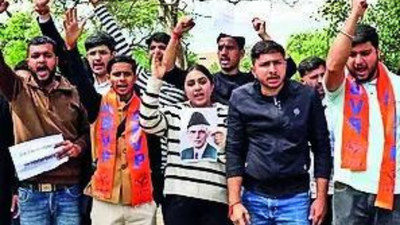
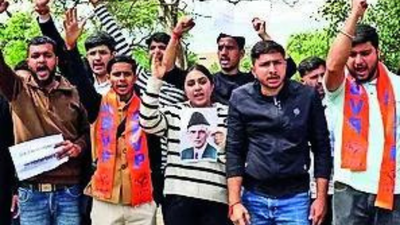
JAMMU: The Vice-Chancellor of Jammu University has constituted a high-level committee to examine the syllabus of postgraduate course in political science after including a chapter on the political thought of Pakistan’s founder Mohammad Ali Jinnah.According to an order issued by the Office of the Dean of Academic Affairs, the committee has been tasked to “thoroughly review the matter and submit a report at the earliest.” The panel will be chaired by Professor Naresh Padha of the Department of Physics, and will include the Head of the Department of Philosophy, History and Sociology and the Director of the Department of Strategic and Regional Studies. Assistant Registrar (Educational Affairs) will serve as Member Secretary.On Friday, ABVP activists protested at the university demanding the withdrawal of Jinnah’s chapter. The protesters, led by ABVP’s J&K secretary Sannak Shrivats, raised slogans against the administration and warned that they would be “forced to launch a strong democratic movement across Jammu and Kashmir” if the content was not withdrawn.“Our government should note that the Department of Political Science, University of Jammu has released its syllabus for 2026-2028… and certain individuals are being presented as representatives of minorities, including Sir Syed Ahmed Khan and Mohammad Ali Jinnah,” Srivats said. These are the same people who propounded the two-nation theory and contributed to partition, and “teaching about them raises serious concerns”, he added.“We will wait and see what the committee suggests. University authorities must understand that academic freedom does not mean disregarding national sentiments,” Srivats added.Professor Baljit Singh Mann, head of the Department of Political Science, on Friday defended the syllabus, saying the inclusion of Jinnah and others was “purely academic” and in line with the UGC norms of universities across the country. “Our intention is to present different perspectives so that students can evaluate the merits and demerits and distinguish between right and wrong. This is an academic exercise, not advocacy,” he said.On Saturday, when asked by reporters, he said he had already clarified his position and stood by what he said a day earlier.