


Why MP’s rising tiger toll is more than a ‘core’ issue | India News


The state lost 32 tigers in the first five months of 2026. Poaching is under control, but electrified fences outside core areas have emerged as a major threat to the big cats. Adding to the concern is the canine distemper virus that has killed a tiger and 4 cubs KanhaFive months, 32 dead tigers and not nearly enough answers. The recent deaths of big cats in Madhya Pradesh, including a tiger and her four cubs in Kanha, have once again thrown the spotlight on the state’s famous tiger reserve. However, the real story behind the growing number of big cats may not lie within their protected boundaries, but outside them. Forest officials said most of the recent deaths occurred outside core reserves, where tiger populations are increasingly clashing with human-dominated landscapes. Here, crude electric wire traps – often set illegally to kill wild boar and other animals for bushmeat or to protect crops – are emerging as the biggest threat to the big cats.Officials say poaching networks once linked to international wildlife trade syndicates have been largely dismantled. But in their place, a more localized and harder-to-monitor threat has spread across the state. Electrocution is now at the center of changing patterns of tiger deaths.Treacherous terrainAccording to the latest tiger estimate conducted in 2022, 785 of India’s total tiger population of 3,682 are in Madhya Pradesh. The state has witnessed one of the sharpest increases in the country’s tiger population, recording a 49% increase between 2018 and 2022 – almost double the national growth rate of 24%.But while tiger numbers have increased, their habitat has not expanded at the same pace. The result, officials said, is an increasing spillover of big cats into protected forests and beyond protected boundaries. Tigers are highly territorial animals and often clash with members of their own species, often forcing weaker, older or younger tigers to move in search of new territory.As reserves become more crowded, many tigers are increasingly pushing into buffer forests, agricultural belts and village fringes in search of space. Officials estimate that about 40% of the state’s tigers now frequent areas outside protected areas, while about 20% move through heavily human-inhabited landscapes crisscrossed by roads, farms and power lines.
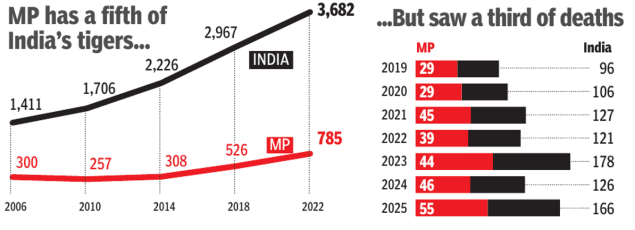
Forest officials say this wide overlap between tiger movement routes and human settlements is driving the changing pattern of tiger deaths in the state. About 80% of tiger deaths reported this year occurred outside protected areas, with several carcasses recovered kilometers away from protected forests. Dispersal movements often bring tigers into direct conflict with villages, while they are threatened in agricultural areas where illegally electrified wires are used to trap or kill herbivores such as wild boar and nilgai.MP’s chief wildlife warden, Samita Rajora, said electrocution has emerged as the most significant threat in this marginal landscape. “Our analysis shows that seven tigers have died this year due to electrocution, mainly from bush poaching or wire snares to protect farms,” he said.Officials said many such traps include illegal tapping of conventional 11kV power lines used for domestic and agricultural supply in villages bordering forests. According to Special Tiger Protection Force (STPF) chief Ritesh Sirothia, poachers or bush poachers often use bamboo poles to hang overhead lines and stretch wires across the animal’s path to create crude live-wire traps.“When an animal comes in contact with the wire, it receives a severe electric shock, causing burns, paralysis and in most cases death,” Sirothia said. “Electrical line tripping records become key evidence in cases like this. Whenever a person, animal or object touches a live wire, it short-circuits the line to ground, which initiates a trip to the power supply. These records capture the exact time, date, duration and location of the disturbance and often help establish timelines and confirm victim incidents.“According to officials, the fringes of Bandhavgarh Tiger Reserve and Pench Tiger Reserve are currently emerging as particularly vulnerable areas. Rajora said, “We are focusing on these high-risk areas and strengthening coordination with the power and revenue departments. Efforts are underway to analyze power-line trip data with GPS locations to identify electrocution hotspots.”Numbers tell a storyData on greater mortality reflects the changing nature of threats facing Madhya Pradesh’s tiger population. In 2025, the state recorded 55 tiger deaths — translating to a mortality rate of about 7%, slightly higher than the national average of under 5%, though officials said it was within ecological limits given the state’s density and growing tiger population.According to data from the state forest department, about 69% of these deaths are due to natural or accidental causes, including regional fights, disease, age, road and train accidents and injuries during collisions. The deaths involved at least 13 cubs under the age of one – a category known to have naturally high mortality rates and, therefore, excluded from national tiger estimates.But officials acknowledge that more worrying trends lie elsewhere. Almost one in every five tiger deaths recorded in the state last year was linked to electrocution, mainly due to illegal live wires. However, officials say most of these incidents do not involve deliberate poaching or evidence of illegal trade in body parts. About 11% of the deaths were in cases of confirmed poaching – instances where parts of the tiger’s body were recovered and the culprits were identified or arrested.Officials highlighted that MP’s relatively high tiger death detection rate also shaped the numbers. Based on 2025 data, the national tiger death detection rate stands at around 54%, while MP recorded a much higher detection rate of around 84%. Officials attribute this to intensive patrolling and surveillance systems that ensure that most tiger deaths, including those occurring in remote regional divisions and buffer areas, are eventually detected and documented.Wire traps, deadly by designAlthough poaching networks have weakened over the years, officials say the threat has increasingly shifted to decentralized actors — bushmeat poachers and farmers using crude electrified wire traps and fences to protect crops.Recent events show how brutal – and difficult to detect – these deaths can be. In Seoni, a tiger died after being electrocuted by an illegal live-wire setup near farmland. Its body was dumped in a well in what investigators suspect was an attempt to destroy evidence. Burnt wires recovered from the site and forensics conducted under National Tiger Conservation Authority (NTCA) protocol confirmed electrocution as the cause of death.In another case, in Chhindwara, a radio-collared tiger shifted from Bandhavgarh Tiger Reserve to Satpura Tiger Reserve was allegedly poisoned and buried, and its collar burnt to avoid detection. Investigators suspect that the killings may be linked to illegal activities in the region, including opium cultivation. Officials also admitted that the delay in responding to callers’ signals exposes loopholes in the monitoring system.The risks are not new, and neither are the warnings. In 2018, the then Additional Chief Secretary (Forest) and Principal Secretary, Energy Department jointly issued directives to officers in all fields, calling for coordinated action to prevent electrocution of wildlife, including joint patrolling, monitoring of power lines and realtime response to line faults. But the ground has changed little.Wildlife activist Ajay Dubey said the power department was reluctant to share responsibility. “If they had come forward for joint patrolling and instant data sharing, the issue of electrocution could have been checked,” he added.Officials, however, said that preventive efforts are now being intensified through coordinated patrols in vulnerable areas, monitoring of illegal power connections, awareness campaigns in marginal villages and action under the Electricity Act, 2003.The threat of ‘killer’ virusesIf electrocution becomes an increasingly dominant threat outside of reserves, disease outbreaks are revealing risks within key habitats. Recently, Kanha Tiger Reserve has been battling an outbreak of Canine Distemper Virus (CDV), a highly contagious disease transmitted from domesticated dogs to wild carnivores. The outbreak killed five tigers from a single family – a tiger and her four cubs.In response, forest officials have introduced emergency control measures across the buffer village adjacent to the Kanha reserve. About 100 dogs have already been vaccinated in eight villages, while a 2 square kilometer forest patch linked to the outbreak has been cordoned off.Rajora said the department has activated a multi-tiered response to prevent further spread. “Since the virus is transmitted through dogs, it is important to vaccinate buffer villages. We have started quarantine measures, vaccination drives and intensive monitoring in the affected landscape,” he said.Officials said water bodies inside the quarantine zone were drained, disinfected using lime and bleaching powder, and temporarily sealed to prevent other wildlife from accessing potential contamination sources. Forest teams have also restricted the movement of tourists and closed entry points to the area.