
Bhojshala dispute: Hindu outfit cites ASI report claiming temple preceded mosque | India News
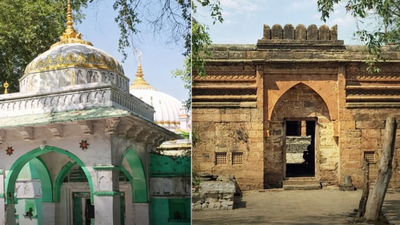
New Delhi: The Hindu Front for Justice on Thursday told the Madhya Pradesh High Court that documents from the Archaeological Survey of India (ASI), including its scientific survey report, support its claim that a temple preceded a mosque at the disputed Bhojshala complex in Dhar district.The Bhojshala complex is considered by Hindus as Bagdevi (temple of Saraswati), while Muslims identify it as Kamal Mawla Masjid. The dispute has led to multiple petitions and a writ appeal on the site’s religious character, which the Indore bench has been hearing on a daily basis since April 6.
In its Public Interest Litigation (PIL), the Hindu Front for Justice claimed that a temple dedicated to Goddess Saraswati stood on the site in the 11th century and its remains were reused to build a mosque after the temple was demolished.On the fourth day of the hearing, advocate Vishnu Shankar Jain, appearing for one of the petitioners, concluded his arguments before a division bench of Justices Vijay Kumar Shukla and Alok Avasthi. Jain submits that a Saraswati temple existed at the site and alleged that “Muslim rulers with a mindset opposed to idolatry” demolished the Hindu shrine and reused its remains to build a mosque in the complex.To support his submission, Jain cited ASI’s 2024 Scientific Survey Report, prepared on the instructions of the High Court, along with its replies and affidavits and historical documents published by the central government agency in 1902 and 1904. He asserted that the ASI supports the case of the petition based on the material, actual condition of the site.“It does not mean that the ASI is taking sides. The ASI is just recording information based on what is on site,” Jain told the court. He also told the court that the report lists several evidences of a temple existing at the site, including remains of religious symbols, Sanskrit inscriptions and statues.However, when Jain started elaborating on parts of the scientific survey report, a senior lawyer representing the Center objected, insisting that it was the job of the ASI consultant to “present” his findings before the court. A lawyer for an intervener on the Muslim side also objected, arguing that the petitioner was relying on a respondent’s (ASI) document to support its case, which is not permissible under the law.After considering the objections, the High Court allowed Jain to highlight some relevant parts of the ASI report, which works under the Union Ministry of Culture.The High Court directed the ASI to carry out a scientific survey of the Bhojshala-Kamal Maula Masjid complex on March 11, 2024. The survey began on March 22, 2024 and ASI submitted its report on July 15, 2024 after 98 days of exercise. The 2,000-page report indicates that a large structure of the Paramara period (9th to 13th century) existed before the mosque, and parts of the temple were reused in the present complex.The Muslim side questioned the ASI survey and rejected the Hindu side’s claim that the site was originally a temple, alleging that some of the materials included in the survey were “introduced from behind.”