

37 years of students’ politics ban on Karnataka campuses | India News
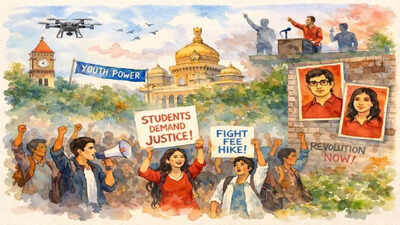
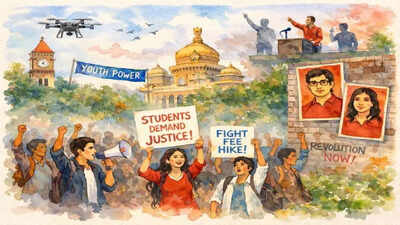
On a weekday afternoon in a government college in central Karnataka, the student notice board is crowded with circulars about exams, scholarships and cultural events. What is missing, however, are the printed campaign posters, and handwritten petitions for votes or calls for debate that once defined campus life in the state. It’s been nearly four decades now since the college corridors of Karnataka went quiet, and stopped echoing with rousing chants from the student community, either protesting or rallying for a myriad of causes. Student union elections remain banned in Karnataka’s colleges and universities, which, some would argue, has made the campuses more politically subservient than in previous decades.Sanctions and a ‘talent crisis’That long silence may now be close to ending — after nearly 37 years, the Congress government in Karnataka has announced plans to revive student union elections in the state’s colleges and universities, relaunching a chapter that was abruptly closed in 1989. Faced with concerns over violence, politicization and academic disruption, it was also a Congress government led by Chief Minister Virendra Patil that put an end to campus politics. When CM Patil announced the ban, it was meant to be a temporary measure, but it continued. Soon, nominated or advisory student councils replaced ‘politically’ elected unions. While students can still raise issues related to fees, hostels and exam delays, formal representation has weakened over time.But the ban and its aftermath have kept alive a debate about the role of educational institutions in shaping democracy, order and future political leadership. They also looked at the political calculus surrounding the state’s once-vibrant student movement, their decline and possible revival.The current Congress government’s announcement to revive campus politics, which came as a surprise to many, was made at the behest of Leader of the Opposition in Lok Sabha Rahul Gandhi. “We need to harness young political talent. It is possible through campus elections,” said Deputy CM DK Sivakumar.An EVM for Campus ElectionsFor many in Karnataka, the government’s efforts to revive campus politics have stirred memories of a time when campuses were vibrant spaces of democratic practice. In 1982, students of MES College in Bangalore lined up to vote in a student union election that would later enter the state’s electoral lore — electronic voting machines, then an innovation, were tested on an experimental basis in college elections. After a year, EVMs were introduced in the assembly elections.At that time, universities were more than places of lectures and examinations. Institutions such as Mysore University, Karnataka University at Dharwad and Bangalore University were known for intense debates on land reforms, linguistic identity, social justice and conservation policies. The student unions functioned as representative bodies elected through regular voting, negotiating with the administration on hostels, scholarships, transport facilities and examination reforms.“Campus elections were our first lessons in democracy,” said MLC and Legislative Council government chief whip Salim Ahmed, a former student leader who later entered mainstream politics. “We learned how to campaign without money, how to talk to people and how to accept defeat.”1970s and 1980sStudent politics in Karnataka in the 1960s and 1970s often mirrored larger social movements. While political parties maintained informal ties to student groups, campuses also saw independent collectives focused on academic and welfare issues. For students from marginalized communities, unions provided an institutional platform to voice concerns that would otherwise have gone unheard.In the late 1970s and early 1980s, however, the nature of campus politics began to change. Student organizations affiliated with mainstream political parties became stronger, and elections increasingly reflected state-level contests. Allegations of financial power, outside interference and involvement of non-students have become common. Ideological and caste-based divisions have sharpened, sometimes turning into violence.Rising through the ranksThe campus was the launchpad for some of the biggest names in contemporary politics. Long before DK Sivakumar became deputy CM and president of the Karnataka Pradesh Congress Committee, his political education began not in party offices or electoral war rooms, but in college corridors. At Sri Jagadguru Renukacharya College in the early 1980s, Sivakumar emerged as a visible student leader associated with the National Students Union of India (NSUI), when campuses were active arenas of debate, mobilization and electoral contests. This exposure, he has repeatedly said, gave him his first lessons in leadership, organization and public involvement.A few kilometers away, and a decade earlier, BK Hariprasad, now a former AICC general secretary and MLC, began his political journey in 1972 as a student activist at Bangalore’s MES College. Raised through student and youth organizations, Hariprasad served as vice-president, four general secretaries of the All India AICC and as a member of the Raj Sabha. His work among the backward classes and the Trinamool network earned him recognition from senior Congress leaders including Indira Gandhi and Sanjay Gandhi.Transport Minister Ramalinga Reddy, an eight-time MLA, rose from student activism as secretary of the student union at a government science college in Bangalore. He was also a member of the student council of Bangalore University. In 1977, he became the president of the university’s student union.Their trajectory — from student politics to the highest levels of the party and government — is now at the center of a new policy debate in Karnataka. “I came up through campus politics myself. Being a student leader helped me in my political career,” says Sivakumar. “Student elections are essential to nurture young political talent.”Probability and other questionsTo examine the framework, feasibility and impact of reintroducing campus elections, the government has constituted a high-level 11-member committee. Medical Education Minister Sharan Prakash Patil has been summoned. The panel includes Higher Education Minister Dr MC Sudhakar, MLAs Rizwan Arshad and B Shivanna, MLCs Salim Ahmed, Basanagowda Badarli and Puttanna, Karnataka Youth Congress President HS Manjunath and NSUI President Kirti Ganesh.The committee has been asked to submit its report within 15 days, Sivakumar said in a December 27 letter. Questions earlier include whether student elections should be conducted under the banner of political parties or in a non-political format and whether reservations should be extended to women, OBC, SC/ST and disabled students.Retired educationist Bandu Upadhyay, who served as principal of the college during some of the tumultuous years of campus politics, vividly recalls the atmosphere then. “Candidates were openly sponsored by political parties. There were sharp divisions among the students, frequent arguments and sometimes clashes. Anti-social elements have also entered the campus,” he said.Academic calendars were often disrupted, police presence during campus elections became routine, and administrators struggled to maintain order. In 1989, under the then Chief Minister Virendra Patil-led Congress government, student union elections were banned across Karnataka.Arguments for and against prohibitionWhat was initially described as a temporary arrangement became a binding policy. Elected student organizations were disbanded and replaced with nominated or advisory councils. Over time, student participation in institutional governance became largely symbolic. Generations of students have gone through college without ever voting for a class representative, let alone a union president.Proponents of the ban argue that it has brought stability. “After the ban, there was less disruption, and the academic schedule became predictable,” said a former university administrator.Critics counter that silence has come at a price. “Banning student elections reflects the lack of confidence among our youth,” said Ravindra Reshme, political commentator and former president of the Federation of Karnataka University and College Teachers’ Association. “It denies students practical democratic training.”Despite the ban, political engagement has not gone away from the campus. Students continued to organize protests around issues like fee hike, exam delay, hostel facilities and reservation policy. Political parties maintained informal networks among students, especially during state and national elections. But these activities lacked elected union structure, accountability and consistency.In some private and autonomous institutions, limited-sized student councils were allowed, largely confined to cultural activities and formally kept apolitical.The student organizations are divided on this. “Campus elections are the first exposure many students get to democracy,” says Adarsh M, an NSUI office-bearer at Bengaluru University. “Elections help identify leaders early and train them in accountability, debate and organization.”AISF activist Srinath Rao said elected unions gave students from marginalized backgrounds a legitimate platform. “Representation without elections becomes symbolic and dominated by nomination,” he said.Campus Front member Mohammad Sajid argues that student elections are about participation beyond party politics. “Even nonpartisan students benefit when the administration is forced to listen to elected representatives,” he says.ABVP expressed some objections. “The campuses exist primarily for academics,” points out Mahendra K, an ABVP worker “We have already seen that in the past, elections have often led to disruption, violence and outside interference. Reviving them without tight security will harm the academic interests of students.”SFI leader Bharath Krishna expressed concern over political implications “There is a danger that campus elections will become an extension of ruling party politics,” he warned, calling for strict enforcement of spending limits and curbing outside interference.Political observers say the Congress government’s move is also driven by organizational considerations. “Unlike the BJP, which has the RSS as a pipeline, the Congress lacks institutional channels to build grassroots leadership,” says political strategist Biswas Shetty. “Campus elections offer one such route.”Political analyst MN Patil points out a bright side of campus politics “Student leaders learn how to organize, strategize and question authority. In their absence, democracy becomes compromised,” he says.Opposition parties reacted cautiously. BJP leaders have warned against politicizing educational institutions. “Colleges should focus on academics,” said Arvind Bellad, senior BJP legislator and deputy leader of opposition in the assembly. “If elections are revived, there must be tight security.” Meanwhile, the JD(S) has taken a more nuanced stance. “Student movements have shaped leaders within parties, but campuses should not turn into battlegrounds,” said a party official when contacted.