


अमेरिकी हमले के डर से किलाबंदी में जुटा ईरान! परमाणु ठिकानों को छिपाने की सैटेलाइट तस्वीरें आईं सामने – Iran rushes to turn nuclear sites into bunkers satellite images ntc rlch
Military tension between Iran and America has reached its peak. Experts are claiming that a war can start at any time in the Middle East, which will last for several weeks. Amidst all this, Iran has started large-scale fortification to protect its most sensitive military and nuclear targets. On the other hand, talks are going on between the two countries in Geneva.
According to a new satellite analysis from the Institute for Science and International Security, iran It is rapidly hiding its important nuclear sites under concrete and soil. They are being converted into strong bunkers so that they can be protected from any kind of air attacks by the Americans.
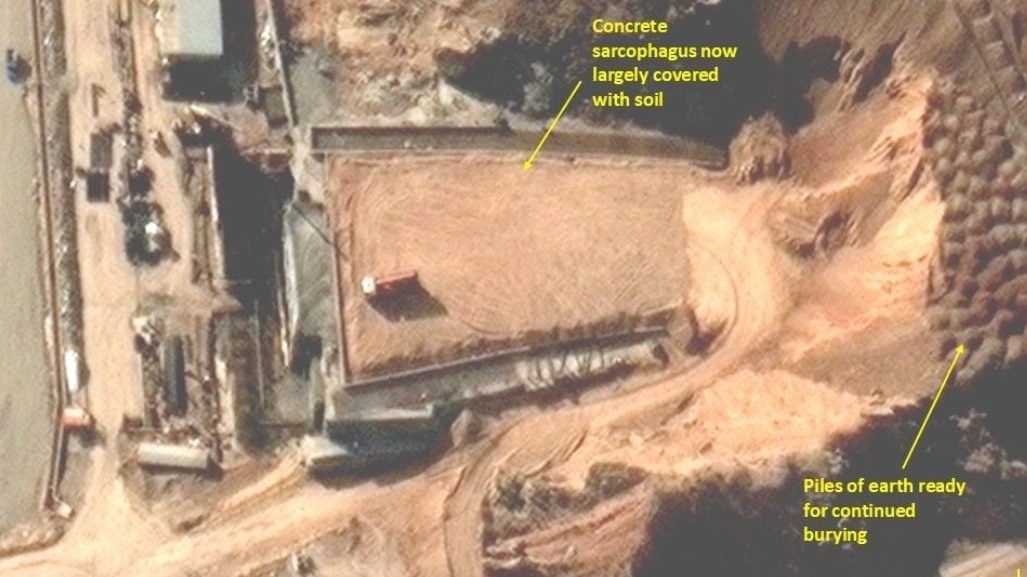
According to the report, the bases which will be handed over to Israel in 2024 and later America Now the work of construction and strengthening security has been intensified there. The institute said in its new assessment, ‘For the last two to three weeks, Iran has been busy burying the new Taleghan 2 facility in the Parchin Military Complex with soil.’

New construction at Parchin military complex
A February 13 satellite image of the Taleghan 2 facility inside the Parchin military complex, about 30 kilometers southeast of Tehran, shows a complete concrete structure surrounding the main structure. Now soil is being poured over it. ISIS President David Albright has warned that this center will soon become an ‘invisible bunker’, on which the effect of air strikes will be negligible.
According to the report, Israel had targeted this complex in October 2024. Satellite images before and after the attack showed extensive damage to a rectangular building and signs of reconstruction by November 2024. Photographs from October 2025 showed the skeleton of the new structure, while in November a metal roof-like structure was seen over it. By December this structure appeared partially covered and completely disappeared in the photographs from February 16. That is, it has been covered with concrete structure and soil.
Tunnels hardened near Natanz
The work of strengthening the tunnels is also going on under the Kolang-Gaj La mountain located near Iran’s famous Natanz Nuclear Plant. Photographs from February 10 show that large quantities of concrete are being poured at the tunnel entrances. To reduce the impact of air strikes, ‘overburden’ (additional layers of soil and rocks) is being prepared. This is where Iran’s two other uranium enrichment plants are located.
“These efforts strengthen the tunnel portal and provide additional protection against airstrike,” the institute said.

ISIS wrote that the images show activity going on throughout the complex related to this effort, including the movement of many vehicles, including dump trucks, cement mixers and other heavy equipment. Iran’s plans for this facility named Pickaxe Mountain are not clear. Previously, Iran had linked construction there to rebuilding an advanced centrifuge assembly plant. However, the size of the complex and its mountains immediately raised concerns about whether more sensitive activities, such as uranium enrichment, were being planned.
Effort to close tunnels in Isfahan also
The Isfahan nuclear complex is one of three Iranian uranium-enrichment plants that were bombed by the US in June. In addition to the facility that forms part of the nuclear fuel cycle, Isfahan also has an underground area where diplomats say most of Iran’s enriched uranium is stored.
ISIS reported on January 29 that satellite images taken in late January showed new attempts to bury two tunnel doors in the complex. In a February 9 update, ISIS said the third door had also been filled with soil, meaning all doors to the tunnel complex were now completely buried. In an image taken on February 10, all three tunnels are seen buried.
ISIS stated on 9 February that backfilling the tunnel entrance would help mitigate any potential airstrike and also make it more difficult for Special Forces raids to reach the ground to seize or destroy any highly enriched uranium contained within.
Activity also seen in Shiraz missile base
About 10 km (6 miles) south of Shiraz in southern Iran, it is one of 25 main bases that can launch medium-range ballistic missiles, according to the Israeli organization Alma Research and Education Center. Alma estimated that the site suffered little damage above ground during last year’s war. A comparison of photographs taken on July 3, 2025, and January 30, shows reconstruction and cleanup efforts underway at the main logistics and possible command compound at the base. Reconstruction work continues on the logistics and command complex at the base south of Shiraz. A new roof has been put on a damaged building at the base north of Qom.
—- End —-